

“We have a no-pets policy.”
An assistance animal is not an ordinary pet. Under the Fair Housing Act, a no-pets policy by itself is generally not enough to deny a valid reasonable-accommodation request for an ESA.
Understand the reason, check your documentation, and take the next step with a calm, clear response.

Work through these in order. Most denials are resolved long before anyone files anything.
Ask your housing provider what specifically was denied and why. Some denials are about a missing form or an incomplete request rather than the animal itself, and those are usually fixable.
Confirm the document is genuine and current using its Verification ID. A letter that cannot be verified is one of the most common reasons a housing provider pushes back.
Your letter should name a licensed professional and their license state. Where an NPI is listed you can look it up yourself in the public CMS NPPES registry.
Politely ask for the decision and its reason by email or letter. A written record matters if the matter escalates, and requesting one is a normal, non-adversarial step.
If you believe the denial was improper, HUD and state or local fair-housing agencies accept complaints. Whether a complaint is appropriate — and how it turns out — depends on the facts and the law that applies to your housing.
Not every landlord denial is unlawful, and filing a complaint does not guarantee any particular outcome. Refunds are governed solely by the PetHousingRights refund policy. This page is educational and is not legal advice.
Five calm steps that keep the conversation constructive and your documentation strong.
Ask for the reason in writing. Many denials come from a misunderstanding — a no-pets policy, a pet-fee assumption, or confusion between an ESA and a service animal.
A valid request is supported by a letter from a licensed mental health provider who actually evaluated you, on letterhead with their license details.
Keep it short, factual, and polite. Reference the Fair Housing Act and your reasonable-accommodation request. Keep a dated copy for your records.
If your need isn't obvious, the housing provider may ask for documentation of a disability and the disability-related need. You don't have to share a diagnosis or medical records.
If a valid request is still denied, you can contact HUD or a local fair housing agency. For serious conflicts, a tenant-rights attorney or legal-aid office can advise you.
Most denials come from a handful of misunderstandings. Here is what each one usually means.
An assistance animal is not an ordinary pet. Under the Fair Housing Act, a no-pets policy by itself is generally not enough to deny a valid reasonable-accommodation request for an ESA.
Pet fees, pet deposits, and pet rent generally do not apply to assistance animals. You do, however, remain responsible for any actual damage your animal causes.
Service animals (ADA) and emotional support animals (Fair Housing Act) are different. For housing specifically, ESAs are covered as assistance animals — a property cannot limit housing accommodations to ADA service animals only.
A housing provider can verify that your letter is genuine and from a licensed provider, but generally cannot require you to buy documentation from a specific company or internal portal.
Breed, size, and weight limits that exist for ordinary pets generally do not apply to assistance animals. A denial usually needs a specific, individualized reason — not a blanket rule.
What matters is a real evaluation by a licensed provider, not whether it happened in person or online. A letter from a licensed mental health professional who genuinely assessed you supports your request; instant, no-evaluation “registrations” are the real red flag.
This specimen is for demonstration only. Its names, dates, identifiers and QR code do not belong to a real person, provider or issued letter.
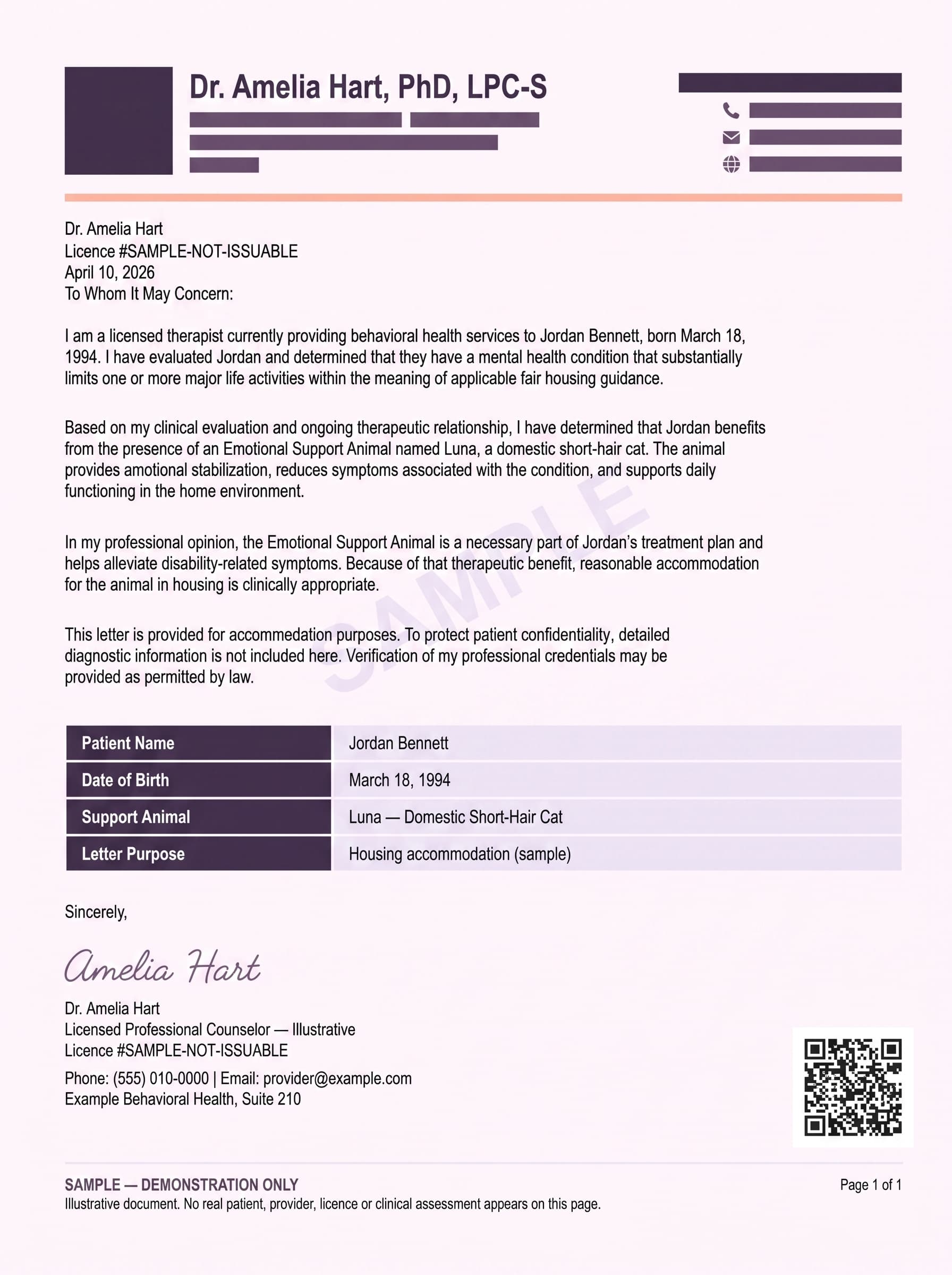
A sample image can show layout and document fields, but it cannot be used to verify a real person, provider, license or clinical assessment.
Your rights are real — and so are a housing provider's. Being clear about both keeps the conversation fair.
When your disability or need is not obvious, they may ask for documentation that reasonably supports it.
In limited cases, a request can be denied if the specific animal would be a direct threat to others' health or safety, or would cause substantial physical damage — when supported by facts, not stereotypes.
A request may be denied if it would impose an undue financial or administrative burden, or fundamentally alter the provider's operations.
You can be held to reasonable, evenly-applied rules — responsibility for damage, leash/clean-up norms, and lawful housing procedures.
This is a plain-English outline — not a legal letter. Adapt it to your own situation, keep it polite, and never use threatening language.
Thank them, and note that you are following up on your reasonable-accommodation request for an emotional support animal.
Mention that the Fair Housing Act asks housing providers to consider reasonable accommodations for assistance animals, and that an ESA is treated differently from a pet.
Note that you have a letter from a licensed mental health provider who evaluated you, and offer to share appropriate documentation of the disability-related need.
Politely ask them to reconsider, and ask for any specific concern in writing so you can address it.
Express willingness to follow reasonable, evenly-applied rules and to discuss any genuine concern.
For a serious or ongoing conflict, consider contacting HUD, a local fair housing agency, or a tenant-rights / legal-aid office. PetHousingRights does not provide legal representation.